Hop on a motorcycle and ride across China. Ride into the West. Out of urban industrialization and into the borderlands. Over packed dirt and concrete to a land still breathing with its own lungs. Bring your friends. If you think you’re dreaming, pay more attention.
From Collages

Monday, July 30, 2007

Day 19: Xining to Qinghai Lake, Qinghai


Distance: 100 km
Expenses: gas 15rmb, hotel 0rmb
Events:
  • P and T went to the Shuijing Xiang Market in the morning. P bought a British looking Chinese hat.
  • D tried to find a place to install a new crash bar on his bike.
  • Missed the motorcycle rally at Qinghai Lake by one day and cycling's Tour of Qinghai Lake by one week.
  • Setup camp at Qinghai Lake, an elevation over 10,000 feet. We collected everything burnable we could find for our campfire.
  • At night we ascended the tallest dune in sight, our path lit by the moon. This is perhaps the most remote place any of us have been in China.
  • A strong wind came at night, forcing us to reset our tarps to a more secure position.
  • Decided to go north from Xining instead of from Qinghai Lake.

Sunday, July 29, 2007

Day 18: Dongxiang to Xining, Qinghai


Distance: 320 km
Expenses: gas 35rmb, hotel 40rmb
Events:
  • Spectacular views on an unbelievable ride, winding along, around, and through the mountain ridges.
  • We came upon a lake we did not expect, and took the ferry across.
  • In Xining, T and P could not find a place that served dumplings. Muslim areas serve noodles, more noodles, and only noodles. Instead they found a 'western restaurant' whose sandwiches left much to be desired.

Saturday, July 28, 2007

Day 17: Lanzhou to Dongxiang, Gansu


Distance: 205km
Expenses: gas 20rmb, hotel 68rmb
Events:
  • Found a small Muslim hilltop town shaped like a crescent with the inner bowl holding a sports complex and pond.
  • The resident's adherence to Islam forbids them to smoke or drink. Beer is not served in any restaurants in town.
  • We all slept in our own hotel room. Later it was agreed that we should have stayed an extra day.
  • We all went on a walk together, but separated and had different experiences. D and T found a nice family that 'adopted,' fed, and took pictures with them. P was taken via moped to meet some random guys (non-Muslim) to drink some beer and learn the 'hand' drinking game.
  • For a tourist town, its people were unusually friendly. We wondered how long it would be before the rude, demanding tourists and their money change the feel of this delightful place and its people. Also, how long can the restaurateurs last without selling beer, a breach of their faith?

Friday, July 27, 2007

Day 16: Into Lanzhou, Gansu

Distance: 70 km
Expenses: gas 0rmb, hotel 43rmb
Events:
  • The road into the city was dissected and had been sacrificed in the creation of an expressway, thus the ride took longer than expected.
  • We were led through Lanzhou, the city with the worst traffic in China, to the dealership where they changed our oil and replaced some parts on D's bike. Tape was heavily used. (see picture)
  • The 'triad picture' was taken at the Lanzhou dealership.
  • The most impressive parts of the city seem to be its hot cycling chicks and the 'circus brothel.' As for that fine establishment, no one took part in its circus or brothel components.

Thursday, July 26, 2007

Day 15: Zhongwei, Ningxia to Lanzhou outskirts, Gansu

Distance: 270 km
Expenses: gas 35rmb, hotel 53rmb
Events:
  • A large tourist trap with the world's largest sand slide on the way out of Zhongwei.
  • We rode through the desert in the morning and then over rolling hills and valleys in the afternoon.
  • Workers were placing hay in the road and sifting it with pitchforks in a process to extract the seeds.
  • We came upon the set for the movie Myth, an attempted replica of the Mogao Caves. The real thing awaited us in Dunhuang, so we kept on moving.
  • Road conditions and the coming nightfall prevented us from an attempt on Lanzhou.

Wednesday, July 25, 2007

Days 6 to 14: Rundown Continued

Day 6: Jingpeng to Xilinhot (Xilinhaote), Inner Mongolia
Distance: 173 km
Expenses: gas 35rmb, hotel 50rmb
Events:


Day 7: Xilinhot (Xilinhaote) to Huade, Inner Mongolia
Distance: 275 km
Expenses: gas 40 rmb, hotel 40 rmb
Events:


Day 8: Huade to Hohot (Huhehaote), Inner Mongolia
Distance: 365 km
Expenses: gas 15 rmb, hotel 50 rmb
Events:


Day 9: Hohot (Huhehaote), Inner Mongolia
Distance: 0 km
Expenses: gas 0 rmb, hotel 50rmb
Events:


Day 10: Hohot (Huhehaote) to (Unnamed City II), Inner Mongolia
Distance: 285 km
Expenses: gas 47 rmb, hotel 53 rmb
Events:


Day 11: (Unnamed City II) to Wuhai, Inner Mongolia
Distance: 305 km
Expenses: gas 25 rmb, hotel 50 rmb
Events:


Day 12: Wuhai, Inner Mongolia to Yinchuan, Ningxia
Distance: 195 km
Expenses: gas 30rmb, hotel 60rmb
Events:


Day 13: Yinchuan to Zhongwei, Ningxia
Distance: 220 km
Expenses: gas 20rmb, hotel 30rmb
Events:


Day 14: Zhongwei, Ningxia
Distance: 100 km
Expenses: gas 20rmb, hotel 30rmb
Events:


Tuesday, July 24, 2007

Great Wall, Great Man


The Chinese say you are not a hero until you touch the Great Wall: bu dao chang cheng fei hao han.

Sunday, July 22, 2007

Rundown


Since the three of us are doing a poor job of blogging daily, I'd like to do a quick run through of major occurrences for curious readers:


1. Patrick crashed on the second day just outside the city of Tongliao, Inner Mongolia. He was not seriously injured. His bike needed 1000 yuan worth of repairs. It was dark when the accident happened. Memorable quote: Patrick to David: "If you turn on your brights, you can go faster."


2. A day after Patrick crashed, we rode through a construction site that was supposed to be a highway. The turnouts were muddy swaths, some of which led to deep ditches dug out for bridges. The kicker is that we rode the toughest section in the dark. At one point, we followed a van full of construction workers who we believe would have mugged us if we hadn't turned tail. Somehow we picked our way through the dirt side roads and construction equipment using only our headlights. Memorable quote: Tristan to Patrick and David as the sun is setting: "We only have another twenty kilometers."


3. In Hohhot, the capital of Inner Mongolia, David was stopped by the police while riding without his helmet. His motorcycle was impounded. After contacting Feiying and paying a 500 yuan ticket for driving without a license, David was able to get his bike back. We left the city early the next day.


4. Two days ago, David and I collided after we passed a dump truck near Yinchuan in the Ningxia Autonomous Region. My bike swerved wildly into the left lane, but I was able to regain control. David's bike tumbled into a dirt turnout in front of some shops, spilling David without serious injury, but doing a number to the right side of his bike: broken headlight casing, bent rear brake pedal, and a cracked engine case (to name the most visible wounds). We were able to get the bike into ride-able condition at a Yamaha repair shop. We soldier on.


On a lighter note:

We have made our way through the long arc of Inner Mongolia and are now in Ningxia on our way to Gansu, Qihghai, and Xinjiang. Before Hohhot, Inner Mongolia is a continuous expanse of grasslands. Most of the highways we traveled are new and traffic-less, save the occasional Jeep, semi, tractor, or donkey cart. Around Harbin, and throughout the Northeast, farming has become mechanized, but in Inner Mongolia you still see donkey-led plows. The remoteness of Inner Mongolia and the simplicity of the lifestyle there make it an enjoyable place to ride a motorcycle. What Inner Mongolia lacks, history and mystery--even Hohhot, clean and orderly, and Baotou, the large urban-industrial complex masquerading as a city, don't have much to offer--, should be plentiful in the upcoming provinces.

Thus far, Ningxia has given us what we had hoped for from the beginning: desert and mountain scenery, places away from motor vehicles and tourists to get off the bikes and walk around, and under-visited and under-preserved pieces of Chinese history.

Today, we were able to visit a temple, Da fu si (Big Buddha Temple), built into the side of a cliff. We also hiked to two remote, crumbling parts of the Great Wall, one of which was high on a mountain overlooking sand dunes. And finally, we rode our bikes up to the rolling desert only ten kilometers from the muddy Yellow River. Standing at the top of the dunes reminded me of the Chinese proverb: bu dao huang he xin bu si.

Tomorrow we ride to Lanzhou, capital of Gansu province and the first major city on the Yellow River's eastward flow.

T

Monday, July 16, 2007

Day 5: Tianshan to Jingpeng Zhen, Inner Mongolia


Distance: 260 km
Expenses: gas 25rmb, hotel 40rmb
Events:
  • Arrived in Jingpeng via tunnel.
  • D and T hiked in the surrounding mountains.
  • D and T met a young boy and girl who hiked with them and, afterwards, invited them on a tour of the walled compound that was their home. D and T helped the children and their family load a truck with dynamite.
  • While inside the TNT family's home, the young boy showed D and T his collection of VCDs, pointing to Terminator and indicating that it is his favorite film.

Sunday, July 15, 2007

Day 4: (Unnamed City) to Tianshan, Inner Mongolia

Distance: 190 km (118 mi.)
Expenses: gas 45rmb, hotel 47rmb
Events:
  • Found that our Pinyin (a system for transliterating Chinese) map was wrong and bought a new, laminated map of Inner Mongolia.
  • Followed three teenage girls to an Internet bar.
  • Took a late afternoon hike up Tianshan, the mountain for which the town was named.
  • Met and ate dinner with an English student recently graduated from a university in Hohhot (Huhehaote). She told us that Tianshan was famous for having the oldest tree in the world nearby, but the tree had been moved somewhere else.

Saturday, July 14, 2007

Day 3: Tongliao to (Unnamed City), Inner Mongolia

Distance: 205 km (127 mi.)
Expenses: gas 25rmb, hotel 67rmb
Events:
  • Waited two hours for P's bike to be fixed at the Tongliao Feiying delearship. The repair job cost 1,000rmb.
  • The Tongliao Feiying delear led us out of town with a bunch of his riding buddies on their tricked out bikes.
  • Encountered massive construction on the road out of Tongliao, but decided to ride on. We found later that we were actually on the wrong road, headed the wrong direction.
  • Rode, for the second straight day, in the dark despite warnings from some dump truck drivers. T easily convinced D and P to ride
    on after saying, "it's only another 20 km."
  • A van full of construction workers, who asked us to follow them through the construction zone, stopped at a dead end, turned off their lights, and emptied the van to confront us.
  • T lost his right crash bar as we drove into the city.
  • At a later dinner, we ate our first potato chuan(r) while speaking to some drunken Mongolians.

Friday, July 13, 2007

Day 2: Baicheng to Tongliao, Inner Mongolia

Distance: 490 km (304 mi.)
Expenses: gas 50rmb, hotel 73rmb
Events:
  • While riding in the dark, P crashed soon after advising D that "if you use your brights, you can go faster."

Thursday, July 12, 2007

Even More on July 11

A few other things:

Before we left Harbin, the Feiying dealership rigged up some flags for us to ride with (see our pictures). These flags have served many purposes: to attract curious Chinese, to bring validity to our presence on China's roads, to make packing and unpacking our bikes a little more of a headache, and to promote Feiying motorcycles. The flags are already thoroughly roughed up. I lost mine on day two, but luckily the dealer had given us an extra.

On the highway between Songyuan and Baicheng my bike began to behave strangely, cutting the flow of gas to the engine as soon as I reached a certain speed. A quick once over of the bike revealed that a portion of the gas line had lost its clip and disconnected from its mount. David had bought zip ties and I used one to reattach the rubber tube. After twenty minutes we were on the road again. Comically, the bike continued to sputter, acting as though it was still having problems with gas flow. This worried me until Patrick suggested I close the choke which we had been playing with when the bike first began to have problems.

Coming in to Baicheng our plan was to continue to Ulanhot after we ate chuar and drank cokes and bought smokes--David smokes and Patrick is trying to get addicted. We were on our way out when it began to rain. Combined with the coming dark and a flash of lightning, the rain was enough to turn us around, and we scuttled back to find shelter in a lover's inn.

(What Patrick has called a "guest house," I call a "lover's inn," because typically they are places where young lovers go to escape their school dormitory buildings.)

T

More on July 11

We knew before leaving that Inner Mongolia would be remote, with a lot of natural scenery and few cities. In fact, the route was chosen for these exact reasons. Every other route out of Harbin would have taken us through big cities, each being very similar to the last. The route has turned out to be what we expected and more. Conditions have been prime: pristine highways much of the way, little traffic, and perfect weather. However, things rarely go as expected, even with great conditions.


Day 1:
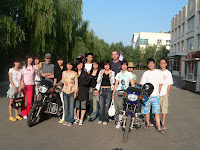
Tristan and I left East College and our students a little after 6 in the morning. Following a little pre-departure picture taking at the delearship, we were led out of town by the Harbin Feiying manager driving his Volkswagen. We quickly learned that we needn't pay tolls on the highways. Instead, we can just go around the toll stations without worry or a lighter wallet. We learned the stares from the toll workers were not because we weren't paying the toll, but because we were foreigners riding motorcycles.

We figured we would get better gas mileage than we really are. It seems we get around 200km for a full tank of gas, far from the 400-450 Martino said he got. The reason for the poor gas mileage might be our speed--80-90km/hr at 8-9,000 rpms. The bikes redline at 10,000 rpms, so we are pushing the bikes almost to their limit. It is hard not to go fast when you have well maintained, traffic-less highways.

The easiest way to find directions is simply to ask someone. Almost every highway, hotel, and city we've found by asking locals. Usually, they are friendly, and usually, they know at least the direction we should go. Before leaving we thought about buying a GPS, but decided against it thinking it wouldn't be that useful. Instead, for directions we have one full map of China in pinyin and "the paper." I bought the map online and had it mailed from the US. Pinyin is the Romanized form of Chinese that makes it easier for foreigners to read and speak the language. The map is fairly nice and we had laminated copies of it made. We also use "the paper," which is a list of cities on our route in both Chinese and pinyin. "The paper" has turned out to be our best tool for getting directions. We can show the Chinese characters to random people we meet on the street.

The map on the other hand has not been as useful. The pinyin doesn't help us decipher street signs. The map has also proven to be unreliable: the first day we found that a city called Songyuan was misnamed Fuyu (later we would find whole highways missing from the map). Lastly, pinyin doesn't help our pronunciation, so showing the characters is easier than trying to pronounce the cities name...usually.

The sights the first day, while interesting, were typically Chinese. Little villages separated by a tremendous amount of farmland. Coming out of Harbin, the land of concrete and taxis, this was a welcome sight. We all know that it will only get better as we enter the grasslands of Inner Mongolia and then the valleys and deserts of Gansu and Xinjiang provinces.

We made our way to Baicheng, approximately450 km from Harbin. Our goal was Wulanhaote (Ulanhot), the first Inner Mongolian city on our route, but it proved too far and the weather didn't cooperate. We slept in a guest house for only 27 yuan a person. Typically, these guest houses are just a room with a bed or two, maybe a window, and, if your lucky, air conditioning (not very comfortable). They do the trick though if all you want is sleep. We finished that night, tired and a little wet. We did have enough energy to go out for a few beers and chuar (grilled meat on a stick). It was exciting...we were on our way.

P (edited by T)

Day 1: Harbin, Heilongjiang to Baicheng, Jilin

Distance: 458 km (284 mi.)
Expenses: gas 75rmb, hotel 27rmb
Events:
  • Gas tube problem on T's bike, repaired using one of D's zip-ties.
  • Attempted to ride to Ulanhot (Wulanhaote), Inner Mongolia, but were forced by the rain and the coming dark to backtrack to Baicheng.

Monday, July 9, 2007

Our Horses: Feiying's 150-3

Chinese motorcycles are different from their American counterparts in both design and use. The affordable, easy to fix bikes are preferred to the expensive, hard to fix, durable type. Also, Chinese people don't ride their motorcycles fast or long. Mostly, they are around town utility vehicles, used by families to go to the nearby market, or as "motorcycle taxis." Motorcycles are banned from expressways, hence they're built for local speeds. A majority of motorcycles here have 125cc engines. If you don't know how much that is, many Harleys have 1000cc engines, or more. Our bikes have 150cc engines, which still isn't very powerful, but will provide decent gas mileage.

So far we have mixed feelings about our new ride. In the few weeks we've owned them, David's already broke down. When it happened, Feiying was immediately on the scene to mend his carburator. And, the next day they replaced the whole bike with a brand new one, without ever mentioning why. The front tire and its tread seem small, especially considering the terrain we intend to encounter, but the rear more than makes up for it in both girth and tread depth. As for Feiying, we don't know much about the company, or about any other Chinese brand, but from what we've read on Martino's blog, this is the bike for us. Martino rode over 10,000km around China on his Feiying 150-3. That's pretty reliable, not to mention, the sleekest Chinese bike on the road.

These are some of Patrick Martino's thoughts on the bike:
"Examining the bike from the advertisement, a stylish black FY 150-3, I became increasingly impressed. The bike had quality parts including a Yamaha engine, Yamaha shocks, and high quality tires from Taiwan. Better still Yu Jian told me the bike ran on specially designed oil which would last for 5,000 kilometers before having to be changed - a definite plus considering the oil problems I had with my last bike. The bike was also was comfortable to ride and just plane looked cool. It was black and looked like a small Yamaha Ninja. It also seemed, however, a little bit too cool and a little bit too expensive. Plus I had never heard of the brand."

P

Saturday, July 7, 2007

26,25,37, maybe I'm wrong about the ages.

We have a great team. One day Tristan will be our leader, the next day it will be Patrick, and the next me. "Only the rising of the sun and the setting of the moon can tell us who has it in them to lead ." We shall all be generals and will stand up according to the day we face. We have not put our horses on the trail, but when we do, I will tell you more. One thing the three of us have in common is that we want to get on our horses and just ride. We don't ride to say "I'm better than you," but to say it's as simple as getting on your horse and riding. Today is today, as common as tea and coffee and an U. July 11th is a new day.

Over

D (edited by T)

Friday, July 6, 2007

Mark it down

The date of departure has been determined: July 11, 2007

Thursday, July 5, 2007

Independence

Here on our Independence Day, we would like to pay tribute to our two homes and their respective freedoms: the freedom of speech and...the freedom to ride motorcycles thousands of miles without licenses, insurance, nor the ability to read the language.
P


Wednesday, July 4, 2007

All the Pretty Horses

In Cormac McCarthy's All the Pretty Horses, two young men from Texas wander on horseback into Mexico where they search for work and a meaning for their lives. After buying sleeping bags and pads and tents, I can't stop imagining myself as McCarthy's hero, John Grady Cole: strappin' on my bedroll and saddlin' up and ridin' all night and sleepin' under the stars. Granted, my horse is mechanical and my "bedroll" is camping equipment and I won't be "ridin' all night" or "sleepin' under the stars" nor have I ever worked on a ranch or been put into prison or used a gun to threaten or kill someone. And I don't plan to. But maybe wandering is just about finding yourself or finding that elusive meaning, wherever you come from and however it happens.

T

Sunday, July 1, 2007

Martino, the Hero, the Inspiration

Patrick Martino. You have probably never heard this name before, but neither had we before deciding to venture across China on motorcycles. Patrick traveled from Lanzhou to Urumqion a motorbike, taking a similar route to the one we are taking on the second leg of our trip. However, he didn't stop there. He also traveled even farther West and also south to Tibet. Even after having an accident on his Feiying bike he continued to travel. He didn't travel with two other Americans like we will. He traveled alone.

After many Google searches using phrases like "motorcycle china" and "across china" we found Patrick's blog (click here to view), full of information about traveling China on a motorcycle, specifically the Northwest. Perhaps the most helpful information on the blog, was his recounting of how he stumbled into a sponsorship with Feiying Motorcycles. One day after finding his blog site, we went to the Feiying dealership in Harbin and our trip became much easier. Feiying was willing to 'sponsor' us just as they had sponsored Martino: giving us good prices on the bikes, finding us places to stay and food along the way, supplying helmets, gloves, license plates, and, maybe most importantly, free repair and maintenance for our bikes during the trip.

P (edited by T)

Friday, June 29, 2007

Just don't let them know we understand...

Feiying tanked in their effort to obtain licenses for us despite petitioning multiple municipal motor vehicle divisions. We supplied the dealer with application forms, physical evaluation forms--we paid 10 rmb for a nurse to certify our height and weight, both of which we lied about--, translations of our U.S. driver's licenses, letters from our respective schools, copies of our visas, and 6 passport photos. These items weren't impressive enough even alongside the hefty bribe we were willing to slip the first wavering local official.
This minor setback has not deterred us. We still plan to carry on with ignorance as our shield. The dealer has assured us that there would be no serious legal repercussions if we were stopped by the police. Whether this is really the case is moot. There is no stopping us now.
I want to take this chance to introduce what I believe should be the guiding principal of our journey: "bu dao huang he xin bu si," a well-known Chinese proverb that has two somewhat contradictory interpretations. The first, "do not stop until you reach your goal." And the second, "refuse to give up until all hope is gone."

T

Friday, June 15, 2007

Necessities

Neither Tristan nor I knew how to ride a motorcycle until today. This is obviously a necessary skill if we want to cross China on one. We have intentionally failed to mention this little fact to our sponsor, Feiying Motorcycles. Although they might not care about our lack of skill, we would like them to have plenty of confidence in our ability. To gain experience, our plan is to learn from motorcycle taxi drivers.
Today Tristan, Rodman, and I went to a nearby place where motorcycle taxi drivers congregate and wait around all day, every day. After some negotiation, we found a young driver willing to teach us and allow us to use his bike for practice. We paid 50 yuan for one hour. This is a lot of money for a driver to make in one hour, but considering our inexperience and the possibility of damage, we thought the price was right.
Getting used to the bike didn't take very long. The language barrier didn't matter so much, and within a few minutes we were doing counterclockwise circles around the parking lot like pros.
I do worry a little about the breaking; it is counter intuitive, as my first instinct to stop fast would be to grip the right hand brake. If I did that, it would engage the front break, flipping the bike. The right foot pedal is used for the rear break.
By the time we get the bikes, we should be confident enough to ride away from the dealership like we know what we're doing.


P (edited by T)

Sunday, June 10, 2007

The Plan

Harbin, China: 3 American teachers, inspired by opportunity and insanity, plan a road trip that will take them by motorcycle across China: from Harbin in the province of Heilongjiang, through the fertile Northeast and the grasslands of Inner Mongolia, along sections of the Silk Road, to Urumqi in the far West province of Xinjiang.

The People: Patrick Dunlavey, Niskayuna, New York. Taught at East College, now teaches at Harbin Engineering University.
David Andersen, Denver, Colorado. Currently a teacher at Jian Qiao middle school number 3.
Tristan Hanson, Sitka, Alaska. Came to Harbin to teach at East College.

The Route: Beginning from the Northeast capital of Harbin, we plan to ride West into Inner Mongolia to the small town of Ulanhot. Continuing Southwest in a slow arc towards the capital of Inner Mongolia, Hohhot, we will hit various landmarks including Xanadu. Skipping over to Baotou for a quick stop over, we next turn South toward Yinchuan in the Ningxia Autonomous Region. From Yinchuan, we head toward Lanzhou, the capital of Gansu province, the first large city on the Yellow River. Taking some time in Lanzhou to see the surrounding area, including the Buddhist sculptures at Bingling Si, we then continue South towards Xining and the salty Qinghai Lake. Sling-shotting around the lake, we will drive North to Babao and back into Gansu province to Jiuquan, stopping to visit the Jiayuguan Fort. Turning West again, we will go through Yumen and Dunhuang past massive dunes, and cross the border into Xinjiang. Passing deserts and mountains, and visiting the cities of Kumul and Turpan, we will, after 4,000+ miles, end in Urumqi.

Logistics: Before leaving Harbin, there are many things to prepare: mapping the route, choosing motorcycles, brainstorming and obtaining necessary supplies, practicing with the bikes, and other smaller items. We will be aided in our preparations by Feiying motorcycles. After careful research and consideration, Feiying’s quality motorcycles and premium service made our choice easy.

T